What Is Ring Spun Cotton? Specs, Tradeoffs & Uses
When evaluating fabric specifications for apparel sourcing, the distinction between fiber composition and fiber processing is a critical variable. While "100% cotton" describes the material's chemical makeup, it reveals nothing about the fabric's structural integrity, texture, or performance. Understanding what is ring spun cotton requires looking at the mechanical spinning process used to convert raw cotton fibers into yarn. Ring spun cotton is a tightly twisted, high-strength yarn created by continuously thinning and winding cotton fibers, resulting in a noticeably softer and smoother fabric than standard cotton. Unlike standard open-end manufacturing, the ring spinning method aligns, twists, and thins cotton fibers into a continuous, tightly bound strand. This structural difference fundamentally alters the fabric's physical properties, impacting everything from tensile strength and surface smoothness to screen printing viability and long-term durability. For buyers, product developers, and supply chain managers, selecting the right yarn type is a foundational decision that dictates the final garment's market positioning and lifecycle performance.
Ring Spun Cotton: How It's Made (Ring Spinning Process)
The fundamental characteristics of ring spun cotton originate in its mechanical production process. After raw cotton is harvested, cleaned, and carded into thick, loose ropes called slivers, it must be spun into yarn. In traditional ring spinning, these slivers are fed into a ring frame. The machinery continuously drafts (thins) and twists the cotton fibers simultaneously. A small traveler glides around a ring, winding the newly formed yarn onto a rotating bobbin.
This continuous twisting action forces the individual cotton staple fibers to align tightly together in a single direction. The mechanical tension binds the shorter fibers into the core of the yarn, leaving a smooth, uniform exterior. Because the fibers are twisted under constant tension, the resulting yarn possesses higher tensile strength and a noticeably softer hand-feel compared to yarns produced through faster, less rigorous methods. The tradeoff for this structural superiority is production speed; ring spinning operates at a significantly slower rate than modern alternative methods, which directly influences the final material cost.
Ring Spun vs. Open-End (Rotor-Spun) Cotton: Key Differences
To fully grasp the value of ring spun fabrics, they must be compared against the industry standard: open-end (or carded open-end) cotton. It is important to note that "regular cotton" is not a formal manufacturing specification; both ring spun and open-end yarns can be legally labeled as 100% cotton despite their vast structural differences. Open-end spinning skips the roving process entirely. Fibers are fed into a rotor that uses centrifugal force to spin the yarn. While this method is highly efficient and cost-effective, it does not align the fibers as thoroughly as a ring frame.
As a result, open-end yarn has a bulkier, more porous structure with numerous short fiber ends protruding from the surface. These microscopic protrusions create a coarser texture against the skin and an uneven surface area.
| Feature | Ring Spun Cotton | Open-End (Rotor-Spun) Cotton |
|---|---|---|
| Manufacturing Speed | Slower, labor-intensive | Fast, highly automated |
| Fiber Alignment | Tightly wound, unidirectional | Loose, multi-directional |
| Surface Texture | Smooth, soft hand-feel | Coarse, slightly fuzzy |
| Tensile Strength | High (tightly bound core) | Moderate (looser core) |
| Cost Profile | Higher raw material cost | Lower raw material cost |
| Ideal Application | High-end retail, detailed printing | Promotional wear, heavy workwear |
Yarn Count (Singles/Ne): 20s vs. 30s vs. 40s
When sourcing ring spun cotton, specifications frequently include a number followed by "singles" (e.g., 20s, 30s, 40s). This metric refers to the English Cotton Count (Ne), which measures the fineness of the yarn. The number indicates how many hanks of yarn (each measuring 840 yards) are required to weigh one pound. Therefore, the higher the number, the finer and thinner the yarn.
Typical industry ranges for apparel fall into three categories:
- 20s Singles: A thicker, heavier yarn. Garments made from 20s singles are robust and substantial, often used for classic heavyweight t-shirts and durable streetwear.
- 30s Singles: The industry standard for modern retail apparel. This count strikes an optimal balance between softness, drape, and durability, making it the default choice for premium lightweight t-shirts.
- 40s Singles: An ultra-fine yarn used for sheer, highly draped, or extremely lightweight garments. It is exceptionally soft but requires careful handling and construction to maintain structural integrity.
Selecting the correct singles count is just as critical as choosing ring spun over open-end yarn, as it directly dictates the garment's weight, drape, and thermal properties.
Combed Ring Spun Cotton: What 'Combed' Adds
While ring spinning improves the yarn's structure, the raw material can be further refined through a process called combing. Before the cotton slivers are spun, they are passed through fine mechanical brushes (combs) that physically extract impurities and short staple fibers.
By removing fibers that fall below a specific length threshold, the combing process ensures that only the longest, most uniform cotton staples remain. When this combed material is subsequently ring spun, the resulting "combed ring spun" cotton represents the highest tier of cotton yarn. It exhibits minimal pilling, exceptional smoothness, and superior strength, as there are virtually no short fibers left to break loose from the yarn core over time.
Ring Spun Cotton for Screen Printing & DTG (Printability)
The physical structure of the fabric directly impacts secondary manufacturing processes, particularly screen printing and direct-to-garment (DTG) applications. The protruding fibers inherent in open-end cotton create excessive surface hairiness and fuzz. This uneven texture interrupts the smooth laydown of ink, and over time, the loose fibers are prone to pilling, which further degrades the print quality. This requires printers to apply heavier deposits of plastisol ink or use specialized underbases to achieve a crisp image, which can result in a heavy, rigid print area.
Ring spun cotton, particularly combed ring spun, provides a tightly woven, flat substrate. This smooth face allows inks to sit cleanly on the surface or absorb evenly into the fibers (in the case of water-based inks).
Decision Framework for Print Substrates
- IF the design requires high-resolution photographic DTG printing or soft-hand water-based inks, THEN specify 30s combed ring spun cotton to prevent ink bleeding and surface hairiness.
- IF the project involves standard vector graphics using heavy plastisol ink for a high-volume promotional run, THEN standard open-end cotton may be sufficient and more cost-effective.
- IF the garment requires a vintage, distressed, or highly textured print aesthetic, THEN a heavier 20s ring spun or even a slub cotton can provide the necessary structural character.
How to Choose for Non-Print Garments (Comfort, Durability, Shrink)
For apparel categories where printing is secondary or non-existent (such as blank basics, corporate wear, or premium loungewear), yarn selection hinges entirely on physical performance metrics. Sourcing teams must weigh comfort, durability, cost, and dimensional stability to select the appropriate yarn.
Non-Print Decision Flow
- Primary Goal: Maximum Comfort & Drape. Specify 30s or 40s combed ring spun cotton. The removal of short staple fibers via combing eliminates coarse textures, ensuring a frictionless hand-feel suitable for premium retail basics and intimates.
- Primary Goal: Heavy-Duty Durability. Specify 20s carded ring spun cotton. The thicker yarn provides high tensile strength and abrasion resistance necessary for workwear or heavy streetwear, without the premium cost of combing.
- Primary Goal: Strict Cost Control. Specify open-end cotton. If the garment is intended for low-cost, high-turnover use where a slightly coarser texture is acceptable, the faster manufacturing speed of open-end yarn provides significant unit cost savings.
- Primary Goal: Shrink Control. Specify pre-shrunk ring spun cotton combined with synthetic blending (e.g., 60% ring spun cotton / 40% polyester). Pure cotton lacks mechanical memory; blending ring spun yarn with polyester stabilizes the knit structure and drastically reduces dimensional variance after washing.
Sourcing Pitfalls + Spec & Testing Checklist
Transitioning a product line from open-end to ring spun cotton requires a recalibration of unit economics. The slower spinning process and higher raw material requirements (especially if combed) increase the fabric yield cost. However, this upfront cost can be offset by measurable business outcomes; enforcing strict specifications and testing for ring spun cotton can reduce QC rejects and customer returns tied to shrinkage, seam twisting, and premature wear.
Common Sourcing Pitfalls and How to Avoid Them
- Mistake: Assuming "100% Cotton" guarantees a soft hand-feel.
- Prevention: Always specify the spinning method in your tech pack (e.g., "100% Cotton, 30s Combed Ring Spun").
- Mistake: Ignoring the relationship between yarn count and fabric weight (GSM).
- Prevention: Do not specify a 40s single yarn if the target garment weight is a heavy 250 GSM. The fine yarn would require an impractically dense knit structure. Align the yarn count with the intended fabric weight.
- Mistake: Assuming dimensional stability without testing.
- Prevention: Cotton inherently shrinks, but exact rates vary based on the specific knit structure and finishing processes. Instead of relying on universal estimates, require dimensional stability testing according to standardized methods (e.g., AATCC 135 or ISO 6330) before finalizing bulk production.
Actionable Sourcing Checklist
- Tech Pack: Specify the exact yarn count (e.g., 30s) and spinning method (e.g., Combed Ring Spun).
- Tech Pack: Set measurable acceptance criteria for pilling (e.g., Grade 4.0 minimum via ASTM D4970).
- Tech Pack: Define dimensional stability limits (e.g., maximum 5% shrinkage via AATCC 135).
- Tech Pack: Establish spirality/torque limits (e.g., <5% via AATCC 179) to prevent twisted side seams.
- Purchase Order: Require submission of third-party lab test reports for colorfastness and shrinkage prior to bulk fabric approval.
When to Choose Cotton-Like Synthetics Instead
While ring spun cotton offers excellent comfort and printability, it still possesses the inherent limitations of natural cellulose fibers: it absorbs moisture, dries slowly, and is susceptible to gradual color fading and shrinkage. For activewear, corporate uniforms, or high-performance apparel, sourcing teams often pivot to advanced synthetics that replicate the desirable traits of ring spun cotton while engineering out its flaws.
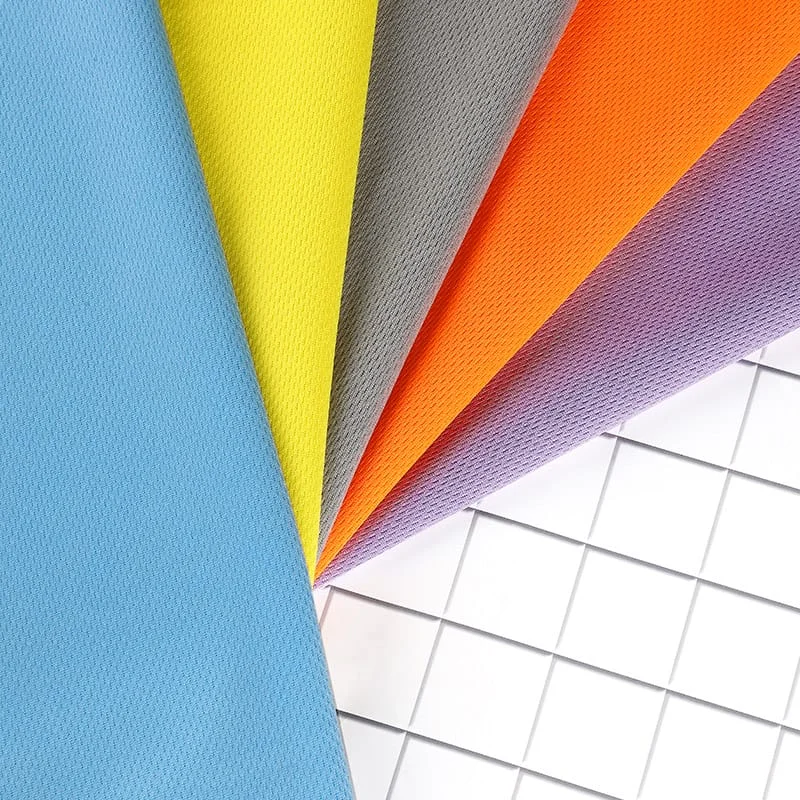
Textile innovators have developed specialized knitting techniques and synthetic yarns that mimic the soft, matte texture of natural cotton. Categories like cotton-like pique fabrics provide the structured, breathable feel expected in traditional polo shirts but utilize synthetic durability to prevent the collar curling and color loss typical of pure cotton. Similarly, synthetic waffle knits and french terry fabrics deliver the tactile depth and thermal properties of natural ring spun textures, but with superior moisture-wicking and shape-retention capabilities.
| Performance Metric | 100% Ring Spun Cotton | Cotton-Like Synthetics (Polyester/Spandex Blends) |
|---|---|---|
| Moisture Management | High absorption, slow drying | Moisture-wicking, fast drying |
| Dimensional Stability | Prone to shrinkage (requires AATCC testing) | Highly stable, resistant to shrinkage |
| Colorfastness | Fades gradually over repeated washes | Retains vibrant color long-term |
| Elasticity & Recovery | Limited natural stretch | High 4-way stretch and shape recovery |
| Hand-Feel | Naturally soft, matte | Engineered to mimic cotton softness |
Evaluating these engineered alternatives allows brands to maintain a premium hand-feel while upgrading the garment's technical performance. High-performance spandex blends can provide four-way stretch and recovery that a 100% ring spun cotton garment cannot mechanically achieve.
Conclusion
The decision to specify ring spun cotton requires precision in both product development and vendor communication. To ensure your fabric specifications align with your product's performance and margin goals, take the following three steps:
- Audit Your Tech Packs: Ensure all cotton callouts explicitly define the spinning method (e.g., Combed Ring Spun) and yarn count (e.g., 30s), rather than relying on the generic "100% Cotton" label.
- Apply the Decision Frameworks: Match your yarn selection to your specific use case. If you are executing high-resolution DTG prints, mandate 30s combed ring spun. If your priority is heavy-duty durability without printing, pivot to 20s carded ring spun or synthetic blends.
- Mandate Standardized Testing in POs: Stop relying on assumed shrinkage rates. Update your Purchase Orders to require third-party lab testing for dimensional stability (AATCC 135 or ISO 6330), pilling (ASTM D4970), and spirality (AATCC 179) before approving bulk fabric production.
Frequently Asked Questions
Is ring spun cotton 100% cotton?
Not necessarily. The term "ring spun" refers exclusively to the mechanical process used to twist and draft the fibers into yarn, not the chemical composition of the fibers themselves. While 100% ring spun cotton is highly common, you can also source ring spun polyester or ring spun poly-cotton blends. The fiber content and the spinning method are two separate specifications.
Does ring spun cotton shrink when washed?
Yes, unless it has been subjected to a specific pre-shrinking treatment during manufacturing. Because it is a natural cellulose fiber, cotton will contract when exposed to heat and water. The exact rate of shrinkage depends heavily on the fabric's knit structure and finishing processes. Sourcing professionals should never assume a universal shrinkage rate; instead, rely on standardized test reports (such as AATCC 135 or ISO 6330) to determine accurate dimensional stability.
What does 30 singles ring spun cotton mean?
The term "30 singles" (often written as 30s) refers to the thickness of the yarn using the English Cotton Count system. It means that 30 hanks of this specific yarn (with each hank measuring 840 yards) are required to equal one pound in weight. In practical terms, a 30s yarn is finer, softer, and lighter than a lower number like a 20s yarn, making it the standard choice for premium, lightweight apparel.
Is ring spun cotton better for screen printing than regular cotton?
Yes. Regular (open-end) cotton has a looser structure with microscopic fiber ends protruding from the yarn, creating a slightly fuzzy surface. When ink is applied, these fibers can poke through the ink layer, causing a rough or faded appearance known as surface hairiness or fibrillation. Ring spun cotton, especially combed ring spun, offers a tightly wound, flat surface that allows ink to lay down smoothly, resulting in sharper, more durable prints.
How can you physically tell if a fabric is ring spun?
The most immediate indicator is the hand-feel; ring spun fabric will feel noticeably softer and smoother against the skin compared to the slightly scratchy texture of open-end cotton. Visually, if you examine the fabric closely or under magnification, a ring spun knit will appear more uniform with a tighter weave and significantly fewer loose, fuzzy fibers on the surface.
Is ring spun cotton warmer or cooler than regular cotton?
Thermal properties depend more on the fabric's weight (GSM) and the yarn count rather than the spinning method alone. However, because ring spun yarn is tightly twisted and often knitted into a denser fabric structure, it can trap slightly more body heat than a highly porous, loosely spun open-end fabric of the same weight. Conversely, fine 30s or 40s ring spun yarns create lightweight fabrics that are highly breathable and cool.